The Weapons
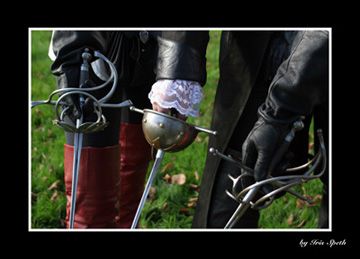
The sword is a weapon several thousand years old, yet in the Middle Ages it became the very trademark of the age. Nobles and knights used the sword not only symbolically but, just as gladly, in earnest combat. To this day the sword retains at least a symbolic significance.
In step with advances in metal extraction and metalworking, as well as the tactical and technical demands of warfare, the sword underwent a marked evolution across the centuries.
From sword to rapier
In the Bronze Age, swords were still short, since "bronze" as a material would bend or break in combat. The Iron Age, and in particular the invention of steel, provided a perfect material, making it possible to forge longer blades as well. Throughout the Middle Ages, the sword evolved stylistically from era to era — meaning its origin can often be dated simply by the shape of its crossguard and pommel.
The strengthening of protective armour in turn drove the development of the armour-piercer (Panzerstecher), a three- or four-edged spike-like blade designed to punch through chainmail or thrust into the gaps of a suit of armour.
The recruitment of peasant armies changed fighting technique dramatically. So-called "Gewalthaufen" — dense pike formations — faced one another, each side trying to break into the opposing formation. The fight would then continue with halberds and finally with swords. By the late 15th/early 16th century this had given rise to the Landsknecht sword, with its characteristic S-shaped crossguard. The term "Katzbalger", often used for it today, is in fact only a modern label coined by collectors of the historicist era. In the primary literature of the Landsknecht period, one finds only terms such as "Schwert", "Swert", "Tegen", "Tögen", "Seitenwehr", "kurze Wöhr", and the like. "Palger" was indeed a term for a weapon used in "katzbalgen" — the period expression for scuffling or brawling — but it did not refer specifically to the short sword of the Landsknechts, which incidentally was not really all that short (roughly 80–100 cm). In the first quarter of the 16th century, the hand protection of the Landsknecht sword was completed step by step through the addition of side rings, a thumb ring, and a so-called "donkey's hoof" guard. This type of sword thus marks the transition from the knightly sword to the rapier.

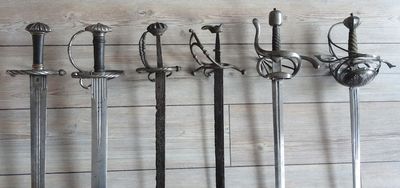
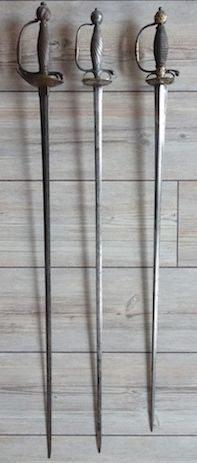
The rise of mobile cavalry called for a lighter, yet longer weapon — one that, naturally, still carried the masculine attribute of a "sword". The term rappier/rapier/rapir/rappir most likely derives from the Spanish "espada ropera", literally the sword worn with formal dress. The term Degen (broadly, "sword" or "rapier" in German), by contrast, is far older, coming from "Tegen", which in the Middle Ages meant sword or even dagger. The two terms are all too often mixed up or used interchangeably. The English have it easier — it is always just "the sword". In France, meanwhile, both "épée" and "rapière" are used, usually without any real distinction. In a military context, blades were always sturdy and flat in cross-section (oval, elliptical, hexagonal, and so on). Only toward the end of the 17th century did a narrow sword with a triangular blade emerge in France — the colichemarde. The name comes from the German-born Otto von Königsmarck, who served as a marshal of the French army; it is a French rendering of his name, much as the "Hakenbüchse" became the "arquebuse". In German-speaking lands, this type of sword — which did not appear until the start of the 18th century — is known as the Galadegen/Galanteriedegen/Kostümdegen (dress sword). It came with either a flat or a triangular blade. The triangular version was especially dangerous: its triangular cross-section gave the blade great rigidity on the thrust, and its sharp point penetrated an opponent with ease. A single thrust could trigger heavy bleeding or a fatal lung wound. This type of sword was never used militarily, only for display. Unfortunately, it also led countless hot-blooded gentlemen and students to duel each other to death over the favour of some charming lady. As a result, the sword with the deadly triangular blade was strictly banned in Germany, regarded as treacherous, underhanded, and "southern" in character — a view that concerned France and Italy rather less. Such swords remained in use right up to the First World War, though by then of no military relevance at all. So that students — who had been forbidden from fencing because of the duels — could still practise the art of fencing, the foil was developed: a purely sporting weapon. Essentially a plain dress sword with a triangular blade and a rounded tip, its point was first blunted with cloth and later with a welded-on ball. As stage weapons, such blades are often combined with rapier or sword hilts, since they are lighter, more flexible, and safer to use. They have, however, nothing whatsoever to do with d'Artagnan's sword...
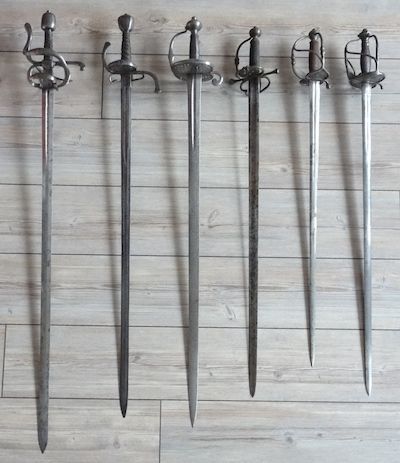
Among the most imposing swords are the hand-and-a-half and two-handed swords (Anderthalb- and Bidenhänder). They saw their main use in the first half of the 16th century. With the two-handed swords in particular, the idea was to use the long blades to cut down the pike-tips of the enemy's dense pike formation and so break into it. In practice, however, the pike-tips were themselves protected by long metal strips running down the shaft, so even long blades achieved relatively little there. In the end, the ensign standing at the centre of the formation — the one guarding the flag — would be surrounded by Landsknechts wielding two-handed swords for protection. In the chaos of close combat, though, these swords proved rather unwieldy and cumbersome. Hand-and-a-half swords were popular for duels and one-on-one combat, while the two-handed sword was chiefly used as a so-called "parade sword" — that is, carried at the front of solemn processions as a symbol of power and strength.
From the short sword to the two-hander, from the cavalry sword to the "Katzbalger", nearly every type is represented today as a stage-combat weapon at the relevant events. What sets these replicas apart from originals is the sharpness and quality of the blade, and the weight. An original sword was light and flexible. Despite the old saying of the time, "too sharp makes it brittle", combat blades back then were sharpened enough that, in practical terms, they inflicted real injuries. Modern stage-combat weapons, by contrast, are thicker in material and therefore blunt and sturdy — but also around 50% heavier, which makes handling the weapon far less nimble. When elegance and skill are replaced by brute force, the authenticity of a fight suffers accordingly for most performers.
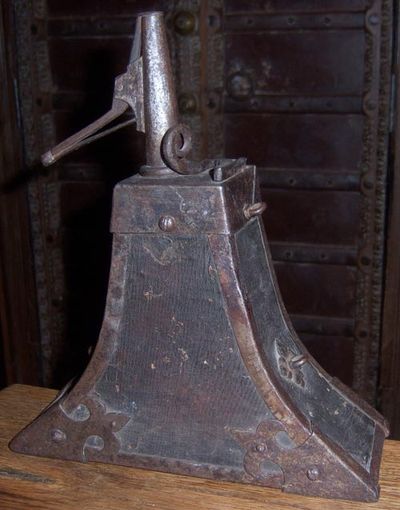
The invention of gunpowder and the development of firearms from the 13th century onward naturally drove edged weapons into gradual military decline. Because the shape of the matchlock's cock resembled the head of a sparrowhawk (Spanish: "muchetus"), the Spanish are said to have coined the term musket ("mosquete"). With muskets came the mounted musketeers, though these could, of course, hardly do without their familiar thrusting and slashing weapons for a good while yet.
Important weapons for infantry troops were the polearms. Chief among these, and the most widespread, were the pikes (up to 6 metres long) and the halberds. The word "Hellebarde" (halberd) is a corrupted compound that clearly evolved from "Halm" (shaft/staff) and "Barte" (axe-blade) — that is, staff and axe. Its origin lies in 1315, at the Battle of Morgarten in Switzerland, where the unarmed peasantry had to defend itself against a vastly superior army of Austrian knights. They fastened all manner of agricultural blades — knives, scythes, axes — to poles, and with remarkable tactical skill managed to crush the invaders decisively. Even today, the term "Halbarte" remains more common in Switzerland. In historical literature, however, one finds countless variant spellings: "Halparte", "Halmparte", "Helleparte", "Helmbarte", and so on. The French "halbarde" or the English "halberd" may perhaps, in turn, have fed back secondarily into the German term "Hellebarde" — language, after all, is always in flux.
Like swords, the halberd underwent an evolution across the centuries. While its earliest form was simply a plain axe-blade with loops for fastening to the shaft, later versions added a hook opposite the blade, used to drag riders down off their horses. The shape of the axe-blade changed too: the initially straight edge gradually became concave, though convex forms are also known. Over time the axe-head grew smaller, while the spike at the top grew markedly longer, turning the halberd into what was essentially a thrusting weapon.